
Guides
Shadow WhatsApp: the customer channel your company cannot see
“We don't allow WhatsApp here”, and yet your advisers are already messaging their customers from their personal phones. What that invisible channel costs, and how to bring it back inside the company without breaking what works.

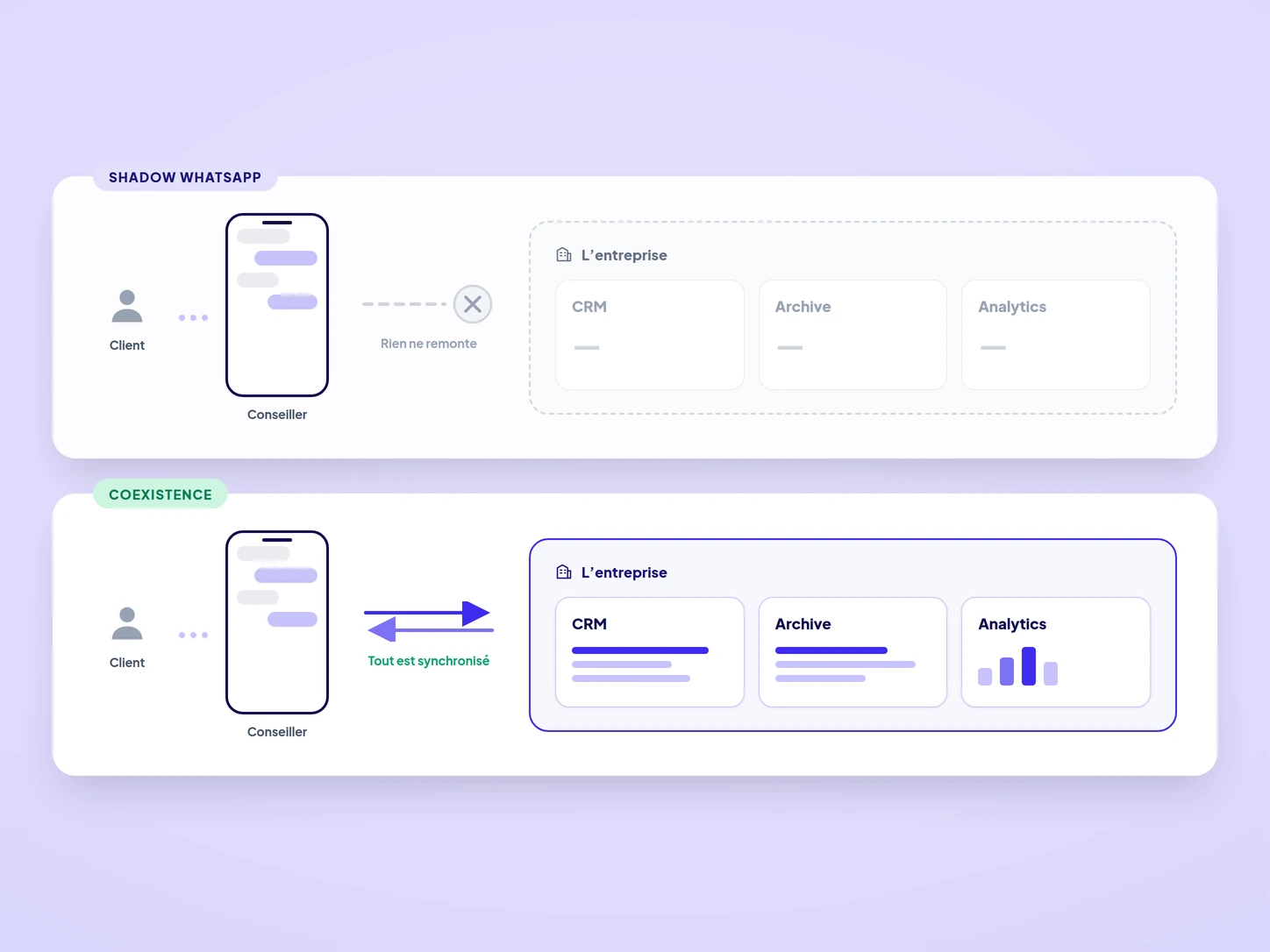
“We don't allow WhatsApp here.” We hear that sentence at almost every first meeting. It is said in good faith: there is an internal memo, an IT policy, sometimes a decision from the legal department. And then, ten minutes later, someone around the table lowers their voice slightly and says: “though between us, the advisers do message their customers on WhatsApp from their own phones.”
Both statements are true at the same time. That is precisely what shadow WhatsApp is: a fully fledged customer relationship channel, used every day, outside every system the company owns. No CRM sync, no archiving, no measurement, no recorded consent. And yet it is often where the real commercial relationship happens.
This is not indiscipline, it is customer demand
The first mistake is to treat this as a behavioural problem. The sales person who gives their personal number to a customer who asked for it is not dodging a rule out of convenience: they are answering an expectation.
A Kantar study commissioned by Meta among 11,056 adults across 22 countries, run between April and September 2025, found that 73.3% of consumers prefer messaging when dealing with a business, that 74.6% trust a business more when they can exchange messages with it, and that 66.8% feel frustrated when messaging is not offered as a way to get in touch. In Switzerland, the Social-Media-Studie 2026 by Zurich agency xeit, based on 1,023 respondents, confirms that WhatsApp remains by far the country's most used messaging app.
The employee who reaches for their personal phone is inventing nothing. They are closing a gap between what the customer expects and what the company provides. As long as that gap exists, someone will close it, one way or another.
The phenomenon reaches well beyond sales. In its State of Secure Collaboration 2026 survey, vendor Wire reports that 42% of the organisations surveyed use WhatsApp, Signal or another consumer messaging app for work conversations, and that 81% say more than a quarter of their sensitive exchanges involve external participants.
What shadow WhatsApp actually costs
The channel works. That is exactly what makes it dangerous: it generates revenue, so nobody is keen to look at it too closely. Here is what you find when you do.
1. A compliance risk already priced elsewhere
US financial services have served as a full-scale laboratory. Since late 2021, the SEC has brought charges against more than 100 firms for recordkeeping failures tied to the use of unapproved messaging (off-channel communications) totalling more than $2 billion in civil penalties. Adding the CFTC, FINRA and UK regulator Ofgem, the running total passes $3.5 billion.
The orders are explicit about the mechanism. In August 2023, the CFTC penalised BNP Paribas, Société Générale, Wells Fargo and Bank of Montreal a combined $260 million: employees, senior staff included, were conducting business over personal text messages and WhatsApp. In January 2025 the SEC added twelve more firms and $63 million to the tally.
You may object that Switzerland is not Wall Street. The legal reasoning, however, travels very well. The revised Swiss Federal Act on Data Protection requires the data controller to protect personal data through appropriate technical and organisational measures, and its criminal provisions allow fines of up to CHF 250,000. One point that is far too little known: those fines target the responsible individual (a director, a data protection officer) and cannot be picked up by the company.
A customer conversation that lives only in an employee's personal phone is neither inventoried, nor secured, nor producible in response to an access request. It does not exist in the record of processing activities. It exists very much indeed on the day of an audit or a dispute. (We set out the applicable framework in our guide to WhatsApp Business and the GDPR for Swiss and European companies.)
2. Your customer database is asleep in someone's pocket
This is the angle that lands fastest with sales leadership. When an adviser leaves, their conversation history leaves with them: the numbers, the objections, the renewal dates, the preferences, the promises made. The company can neither revoke access, nor recover the exchanges, nor even know what was said.
The law does settle the question of ownership, on both sides of the border.
In Switzerland, article 321b(2) of the Code of Obligations is unambiguous: the employee “shall further hand over immediately to the employer everything he produces in the course of his contractual activities”. The address book and the exchange history built up during the contract are part of that. Add the duty of loyalty under article 321a CO, article 6 of the Unfair Competition Act, which sanctions the exploitation of business secrets obtained unlawfully, and article 162 of the Criminal Code, which punishes the breach of a business secret with up to three years, on complaint by the injured company, since prosecution is not automatic. One Swiss caveat worth knowing: a business secret is protected only if the company has demonstrated its intention to keep it secret through concrete measures. A customer database left to live for three years inside an employee's private phone, with no policy and no tool, is a database you will struggle to claim you were protecting.
In France, case law reaches the same conclusion: a customer file built by an employee in the performance of their contract belongs to the employer, and taking it on the way out is a fault that can be litigated.
But the rule is worth nothing if the company never held the data. You cannot demand the return of a file you have never seen, and a WhatsApp history that never left an employee's phone is not “handed over” when they go: it is simply nowhere to be found.
In practice, the company discovers the problem at the worst possible moment: when the sales person leaves, and their successor inherits a portfolio with no history and starts calling customers who have already explained everything three times.
3. A personal account is not allowed to be a commercial channel
Here is a point many companies discover late. WhatsApp's Terms of Service explicitly prohibit, on a consumer account, any “non-personal” use of the app without authorisation: “involve any non-personal use of our Services unless otherwise authorized by us”. Symmetrically, the WhatsApp Business Terms state that a business account must be used “solely for business, commercial, and authorized purposes, and not for personal use”.
In other words: the sales person running their book of business from their personal WhatsApp is not only outside their company's rules, they are outside Meta's. The concrete risk is suspension of the number for breach of the terms of use, with the entire customer history behind it.
4. Nothing can be managed
The rest follows. How many conversations a month? What is the first-response time? What conversion rate compared with other channels? Which questions come back often enough to justify automating them? Nobody knows, because nothing is measurable.
A channel that carries revenue but appears on no dashboard is not merely a risk: it is a strategic blind spot. You cannot optimise it, resource it or budget for it.
Why banning it never works
The reflex response is the memo: “use of WhatsApp with customers is prohibited”. It fails for a simple reason: it does not address the cause. Customer demand does not disappear because a policy has been signed. Sales people are judged on results, not on tool compliance. The channel does not stop: it drops one level further into the shadows.
The ban even has a perverse effect: it makes the subject undiscussable internally. Nobody reports it any more, so the company loses its last source of visibility, the testimony of its own teams.
The way up: make it official instead of forbidding it
The right question is not “how do we stop our teams using WhatsApp”, but “how do we give them the same channel, better, and under company control”. The path has five steps.
Step 1. Size the problem, without hunting for culprits
Before any decision, you need an order of magnitude. Five questions put to the field teams are enough: how many of your customers have your mobile number? on how many deals did WhatsApp play a part this quarter? what happens when you are on leave? where can those exchanges be found? what would you miss if it were taken away tomorrow?
Framing matters: the exercise is there to size a channel, not to sanction anyone. A survey experienced as a witch hunt produces false answers.
Step 2. A company number, not an employee's number
This is the structural shift. The WhatsApp number must belong to the company, not to one person's phone. One number per team, per branch or per service line, with several agents behind it. The customer keeps a named contact; the company keeps its data.
Step 3. Keep the mobile app, add the platform
The teams' legitimate objection is “your tool is going to slow me down”. It falls away with coexistence, the Meta feature that runs the WhatsApp Business app and the Cloud API on a single number, synchronised in real time both ways. The adviser keeps their app, their calls, their responsiveness. The company gains visibility, archiving and automation. Nobody changes their habits.
One prerequisite, to handle as early as step 2: coexistence works with the WhatsApp Business app, not with the consumer account. Moving from the personal account to a Business account is the real first step, and it is also the one that brings the practice back in line with Meta's terms.
Step 4. Connect the CRM, the archive and consent
Beware the connector illusion: plugging WhatsApp into a CRM is not enough, and it is a classic trap. We have explained elsewhere why CRMs miss WhatsApp completely. Once conversations sit in the platform, they become company data: attached to a customer record, archived, exportable, erasable on request. Three points to settle explicitly: where the data is hosted, how long it is kept, and how consent to be contacted on this channel is collected. This is also the moment the channel enters the record of processing activities, where it should have been all along.
Step 5. Automate, but afterwards
AI agents, proactive notifications and message templates come last. A channel you do not measure cannot be automated properly: you do not know which questions deserve an automatic answer, nor at what point a human should take over. Start with visibility and add automation afterwards: that sequence is also what makes adoption acceptable to the field.
Shadow WhatsApp and the official channel, point by point
| Shadow WhatsApp | Official channel | |
|---|---|---|
| Owner of the number | The employee | The company |
| History when an agent leaves | Lost | Retained |
| CRM synchronisation | None | Native |
| Archiving and retrieval | Impossible | Centralised |
| Recorded consent | No | Yes |
| Continuity during absence | The customer waits | Picked up by the team |
| Channel measurement | None | Volumes, response times, conversion |
| Automation | Impossible | AI agents and notifications |
| Meta terms of use | In breach | Compliant |
The one-question test
If you take away only one thing: what happens, concretely, on Monday morning, if your best adviser resigns today?
If the answer sounds like “we pick up their portfolio in the CRM and carry the conversations on from where they left off”, the channel is under control. If it sounds like “we call the customers one by one to introduce ourselves”, you have a shadow WhatsApp, and you have just measured what it costs.
The good news is that the hard part is already done. Your customers have adopted the channel, your teams know how to use it, the relationship exists. All that is left is to bring it back inside the company.
Sources
- Meta / Kantar, The State of Business Messaging, 11,056 adults, 22 markets, April-September 2025.
- xeit, Social-Media-Studie 2026, 1,023 respondents in Switzerland, via Netzwoche.
- Wire, State of Secure Collaboration 2026, consumer messaging use in the enterprise.
- Kirkland & Ellis, Off-Channel Communications, January 2025: more than 100 firms and over $2 billion in SEC penalties.
- LeapXpert, summary of fines: more than $3.5 billion across all regulators.
- CFTC, press release 8762-23, August 2023: $260 million across four institutions.
- White & Case, the SEC's possible last wave, January 2025: twelve firms, $63 million.
- Global Relay, the FCA's position on WhatsApp, and Ofgem's £5.4 million fine.
- WhatsApp, Terms of Service, Legal and Acceptable Use section.
- WhatsApp, Business Terms of Service.
- Graduate Institute, criminal provisions of the revised Swiss FADP: fines up to CHF 250,000, borne by the responsible individual.
- Graduate Institute, data security under Swiss data protection law.
- Art. 321b Swiss Code of Obligations, disclosure and hand-over of work produced, alongside art. 321a CO on the duty of loyalty.
- Business secrets under Swiss law, art. 162 Criminal Code and art. 6 Unfair Competition Act.
- Protecting business secrets when an employee leaves, under Swiss law.
- Village de la Justice, can an employee leave with the customer file? (French law)
Read next


Conversations that convert
A 30-minute demo is enough to see what your WhatsApp channel can produce. In Geneva or by video call.