
Produit
WhatsApp Coexistence: the Business app and the API on the same number
You used to have to choose between your agents' mobility and company control. Meta has just removed that choice. What it makes possible, how to switch it on, and the seven limits to know before you start.

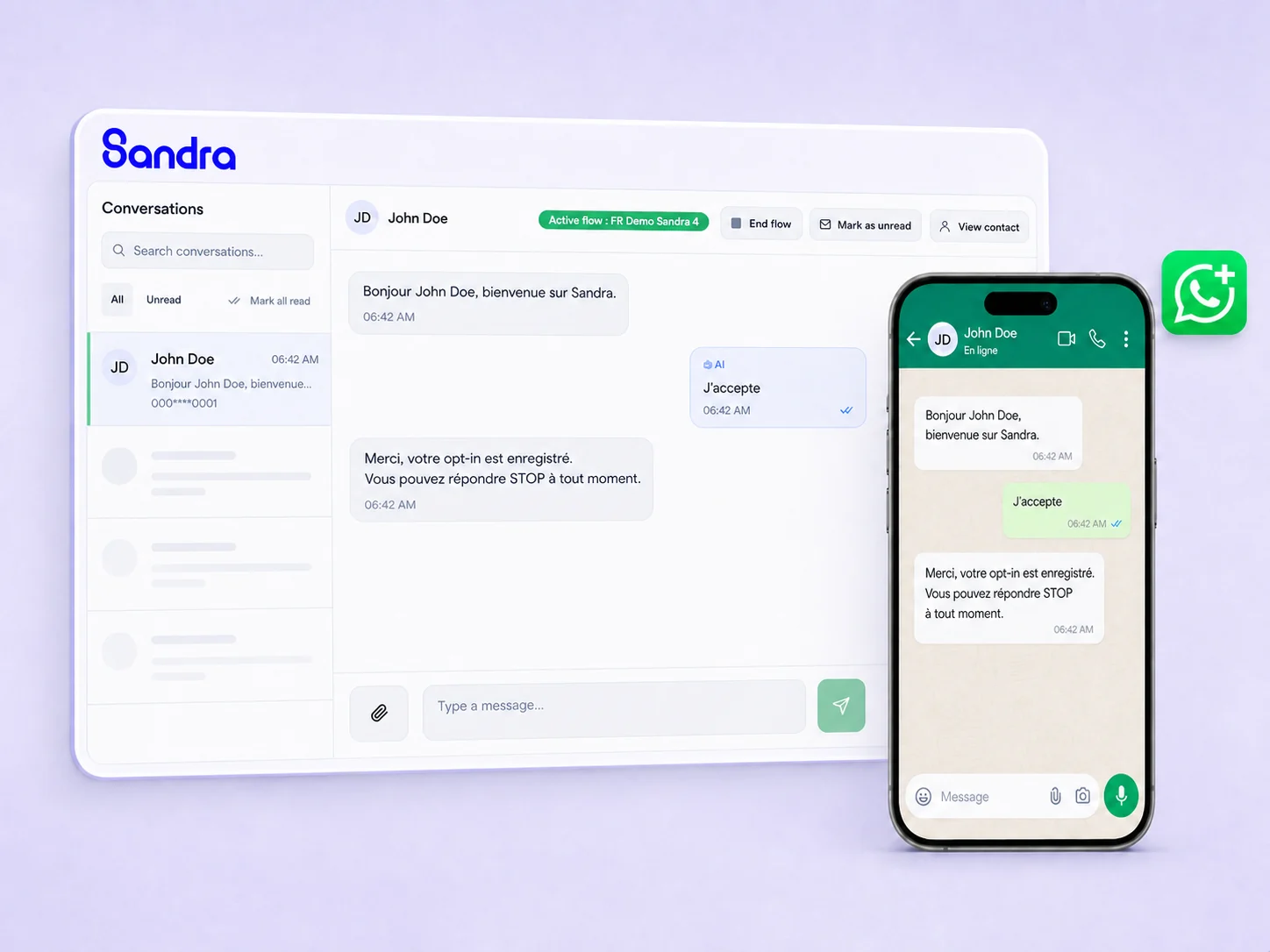
Ever since WhatsApp became a customer relationship channel in its own right, companies have faced an uncomfortable choice. Either their teams use the WhatsApp Business app on their phones (closeness, responsiveness, voice calls, simplicity), but the company has no visibility over those conversations. Or they connect the number to an API platform to gain automation, reporting and compliance, but lose access to the mobile app and the number's entire history.
You had to choose. Not any more. Meta has rolled out a feature (officially "API Solutions for Business App Users", known in the market as WhatsApp Coexistence) that runs the mobile app and the Cloud API on one and the same number, with real-time two-way synchronisation. Sandra supports it natively.
What it actually is
A single number operates in two environments in parallel: the mobile app the agent keeps on their phone, and the Sandra platform, plugged into the WhatsApp Business API. The two stay permanently in sync.
If an agent sends a message from their phone, it appears in Sandra as an echo message. If Sandra sends an automated notification or an AI agent reply, the agent sees it in their chat thread.
This is not a migration. It is a governance layer added to a channel that already exists. The agent doesn't change tools. The company gains visibility, data and the ability to automate.
The problem it solves: the invisible channel
In many organisations, sales people, advisers or field technicians already use WhatsApp Business to talk to their customers, straight from their mobile. It works very well at an individual level. At company level, it creates four real problems:
- No visibility over what was said, to whom, or when.
- Data loss: when an employee leaves, their customer conversations leave with them.
- Compliance risk: exchanges live on a personal device with no archiving, a problem under the GDPR and the revised Swiss FADP.
- No management: no measurement of response times, no automation outside office hours.
Coexistence removes the binary decision between agent mobility and company control. The agent carries on exactly as before; the company gains access to every conversation, plus automation and archiving.
App only, API only, Coexistence: the comparison
| Capability | App only | API only | Coexistence |
|---|---|---|---|
| Agent mobility | Yes | No | Yes |
| Voice and video calls | Yes | No | Yes |
| Automation and AI agents | No | Yes | Yes |
| Reporting and analytics | No | Yes | Yes |
| Archiving and compliance | No | Yes | Yes |
| History at activation | Complete | None | 6 months, text only |
| Agent learning curve | None | High | Minimal |
How it is switched on
Activation goes through Meta's secure flow (Embedded Signup), with no involvement from your technical team. In your Sandra workspace, the Settings → WhatsApp Integration page offers two options: create a new Cloud API number, or connect an existing number in coexistence.
- Choose "Existing number (coexistence)" in the WhatsApp Integration section.
- Confirm via Meta and scan the QR code: you authenticate the Facebook Business account, then the agent scans a code from "Linked devices" in their WhatsApp Business app.
- Enable synchronisation: you confirm the permissions and choose whether or not to import the last six months of history. Two-way sync is then live.
Allow 15 to 20 minutes of onboarding per agent, history included.
The history choice is irreversible. At activation, you import the last six months of text messages, or nothing. That choice cannot be revisited afterwards without disconnecting and reconnecting the number from scratch. Media (images, audio, video) are not included in the import.
What changes, for the company and for the agent
For the company
- Immediate visibility over a channel that already existed but stayed invisible.
- Compliance: conversations move from the agent's personal phone to centralised archiving, at Sandra, hosted in Switzerland.
- Operational management: response times, volumes, performance per agent.
- Gradual automation: start with visibility, then add AI agents, message templates and proactive notifications at your own pace.
For the agent
- No change of tool: they keep the same WhatsApp Business app.
- Native features preserved: voice and video calls, statuses, catalogue.
- Help without interference: an AI agent handles questions outside office hours; the agent takes over whenever they want, simply by typing.
The limits to know before you start
Any serious technology deserves to have its constraints laid out too. Here are the points documented by Meta:
- The WhatsApp Business app is mandatory, not the personal version. Agents on standard WhatsApp must first migrate to the Business version (2.24.17 or later). It's free.
- Throughput capped at 20 messages per second on a number in coexistence, to stay compatible with the app. Worth bearing in mind for mass broadcasts.
- Features disabled in the app once connected: broadcast lists become read-only; disappearing messages, "view once" and live location sharing are disabled in individual chats.
- No group synchronisation, and no support for unsupported devices (WhatsApp for Windows, WearOS).
- The app must be opened regularly: at least once every 14 days to keep the connection active.
- Countries not covered: Nigeria and South Africa are not supported yet. Europe, including Switzerland and France, is.
- Risk of bot / human collision: if an agent replies manually while a bot is active, the customer may receive two answers. This is handled with handover rules that Sandra orchestrates to pause the AI as soon as a human steps in.
On costs: messages sent from the WhatsApp Business app remain free. Only messages, templates and automations sent via the API are billed, according to Meta's Cloud API rate card.
Which companies is it for?
Coexistence is most relevant for distributed sales teams, field teams (technicians, estate agents, advisers) and regulated sectors: banking, insurance, healthcare, training. Anywhere mobile remains the working tool but the company needs control, traceability and compliance.
If you had ruled out the API for fear of disrupting your agents or losing your history, now is the moment to reconsider.
Frequently asked questions
Do my agents lose their contacts and their history?
No. They keep contacts and history in the app, and can import up to six months of text conversations into Sandra at activation.
Do messages stay free?
Those sent from the app, yes. Those sent via the API follow Meta's standard pricing.
What does the company see when the agent writes from their mobile?
Everything. Every message sent and received in the app is replicated in real time in Sandra, as an echo message.
Do we need the personal or the Business version of WhatsApp?
The WhatsApp Business app, without exception. An agent on personal WhatsApp must first migrate to the Business version: it's free and the history is kept.
Is it available in Switzerland and France?
Yes. Europe is covered. Only a few countries, including Nigeria and South Africa, are not yet.
Conclusion
Coexistence isn't a revolution: it is the end of a limitation that forced companies to choose between their teams' mobility and control over their communications. For brands whose teams already use WhatsApp every day, it is a route to professionalising the channel without disruption.
Sandra supports companies in setting up these conversational journeys, from connecting the number to CRM integration, with a platform hosted in Switzerland and compliant with the GDPR and the revised Swiss FADP.
Read next



Conversations that convert
A 30-minute demo is enough to see what your WhatsApp channel can produce. In Geneva or by video call.