

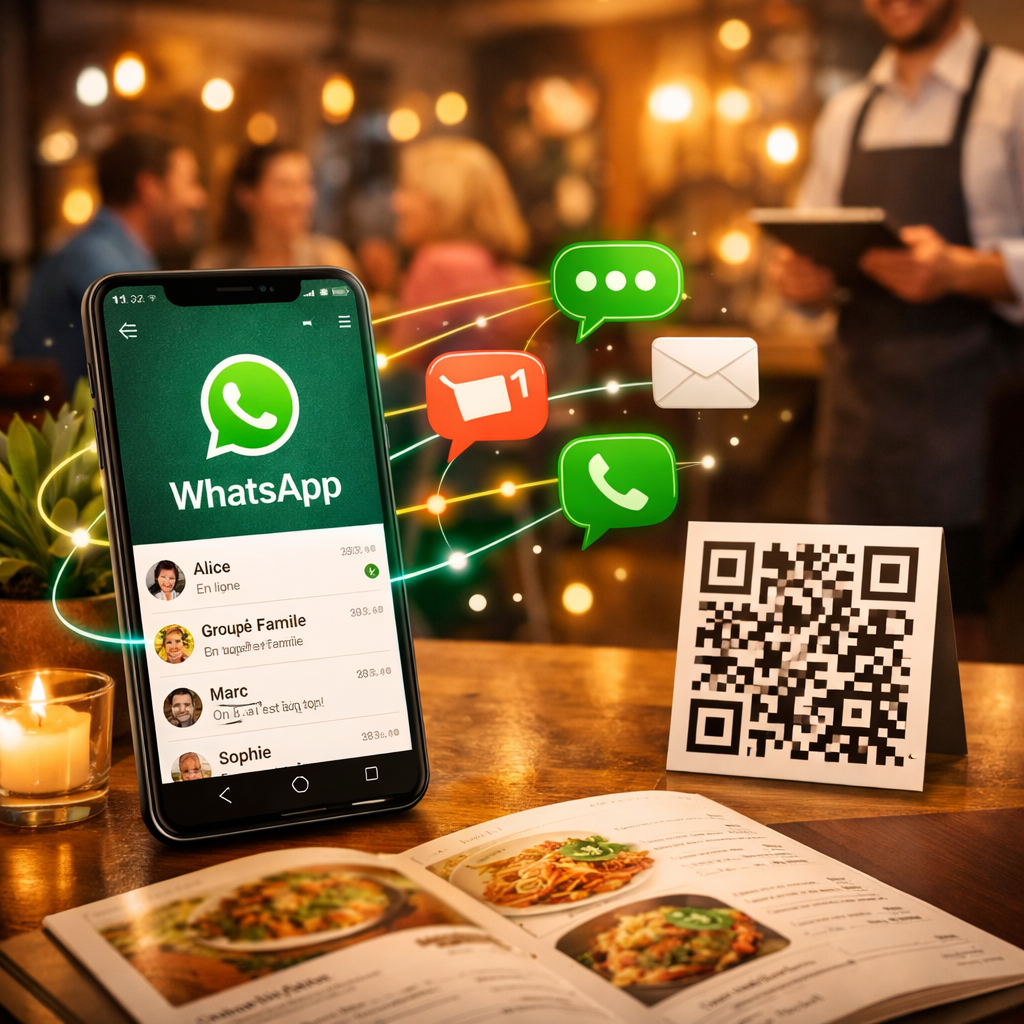
QR codes are everywhere: restaurant menus, advertising posters, product packaging. Yet most brands still use them as a simple shortcut to a URL. That's a missed opportunity. Used with WhatsApp, the QR code becomes an acquisition and traceability lever that neither a landing page nor an app download can match.
Why the QR code is back at the centre of marketing strategies
The QR code long suffered from an austere image. The pandemic rehabilitated it: consumers learned to scan instinctively. Today, scan rates rise year after year across every sector: retail, food service, events, transport.
Adoption is no longer the problem. The problem is what happens after the scan.
Three possible destinations after the scan
| Destination | Friction | Contact capture | Traceability | Re-engagement |
|---|---|---|---|---|
| Landing page | Low | Form required | Partial (cookies) | Limited |
| App download | High | Yes, after installation | Good | Good |
| WhatsApp conversation | Very low | Automatic | Complete | Excellent |
A landing page is still useful for informing. An app download still makes sense for frequent, complex use. But to capture a contact at the exact moment of intent, WhatsApp wins.
Why WhatsApp is the most effective destination
Almost zero friction
Scanning a QR code that opens WhatsApp requires no extra action from the user. No form to fill in, no account to create, no app to install. The user lands in a conversation that is already pre-filled. A welcome message fires automatically. The contact is captured at that precise moment.
A contact captured and traceable from the very first exchange
This is the central point. Unlike a landing page visit, which stays anonymous until the user fills in a form, a WhatsApp conversation identifies the contact from the moment it opens. The brand knows:
- where the user came from (which QR code, which campaign, which store)
- when they scanned
- how they interacted with the first message
Each QR code can point to a distinct WhatsApp conversation, with a different entry parameter. Tracking is native, with no dependence on third-party cookies.
A lasting re-engagement channel
A WhatsApp contact stays reachable. Unlike a web visit that vanishes with no cookie or email collected, a WhatsApp opt-in lets you re-engage the user later: a follow-up, an offer, an update, a satisfaction survey. The average open rate on WhatsApp exceeds 80%, against 20 to 30% for email.
How to structure a QR-code-to-WhatsApp campaign
1. Define the intent behind the scan
Every QR code answers an implicit user question. A QR code on an in-store display answers "how do I find out more about this product". A QR code on an event poster answers "how do I sign up". The opening message must reflect exactly that intent.
2. Create a dedicated entry point
With a platform like Sandra, each QR code generates a distinct WhatsApp conversation with a tracked entry parameter. That makes it possible to attribute every contact to its source: store, campaign, medium.
3. Automate the first sequence
The first message the user receives must be immediate and useful. It can offer information (product sheet, programme, opening hours), an action (registration, promo code, booking) or a qualification (what is your need, your profile, your location). Automation guarantees an instant reply, whatever time the scan happens.
4. Feed the CRM
Contacts collected via WhatsApp flow into existing CRM tools (HubSpot, Brevo, Salesforce) through the API. Each conversation enriches the contact record with the source, the date and the answers to the qualification questions.
Concrete use cases
| Context | What WhatsApp makes possible |
|---|---|
| Retail and point of sale | QR code on a display: product sheet, customer reviews, discount voucher. The sales assistant is notified if the customer asks a question. |
| Events | QR code on an invitation or badge: registration, programme, automatic reminder the day before. |
| Food service | QR code on a table or menu: ordering, loyalty, post-meal satisfaction survey. |
| Outdoor advertising | QR code on a billboard: a conversation with a geo-targeted offer and promo code. |
Frequently asked questions
Do WhatsApp QR codes work on every phone?
Yes, on any smartphone with WhatsApp installed, more than 3 billion users worldwide. The scan opens the app directly, with no intermediate step.
How do I know which QR code generated a contact?
Each QR code carries a unique entry parameter. The platform identifies the source when the conversation opens and records it in the contact's profile.
Can several QR codes be used for the same campaign?
Yes, and it is even recommended, so you can compare performance by medium: shop window, poster, packaging, printed mailing.
How is this different from a QR code to a mobile app?
Downloading an app involves several steps that cause heavy drop-off. WhatsApp is already installed on almost every smartphone.
Is a WhatsApp contact GDPR compliant?
The conversation constitutes explicit consent: the user initiates the exchange themselves. The Sandra platform is hosted in Switzerland and complies with the GDPR and the revised Swiss FADP.
Conclusion
A QR code is a touchpoint, not a destination. What counts is what happens after the scan. Redirecting to WhatsApp rather than a landing page or an app download means choosing the channel that captures the contact, traces the source and enables re-engagement, with no friction, no form and no dependence on cookies.
Read next

Conversations that convert
A 30-minute demo is enough to see what your WhatsApp channel can produce. In Geneva or by video call.