

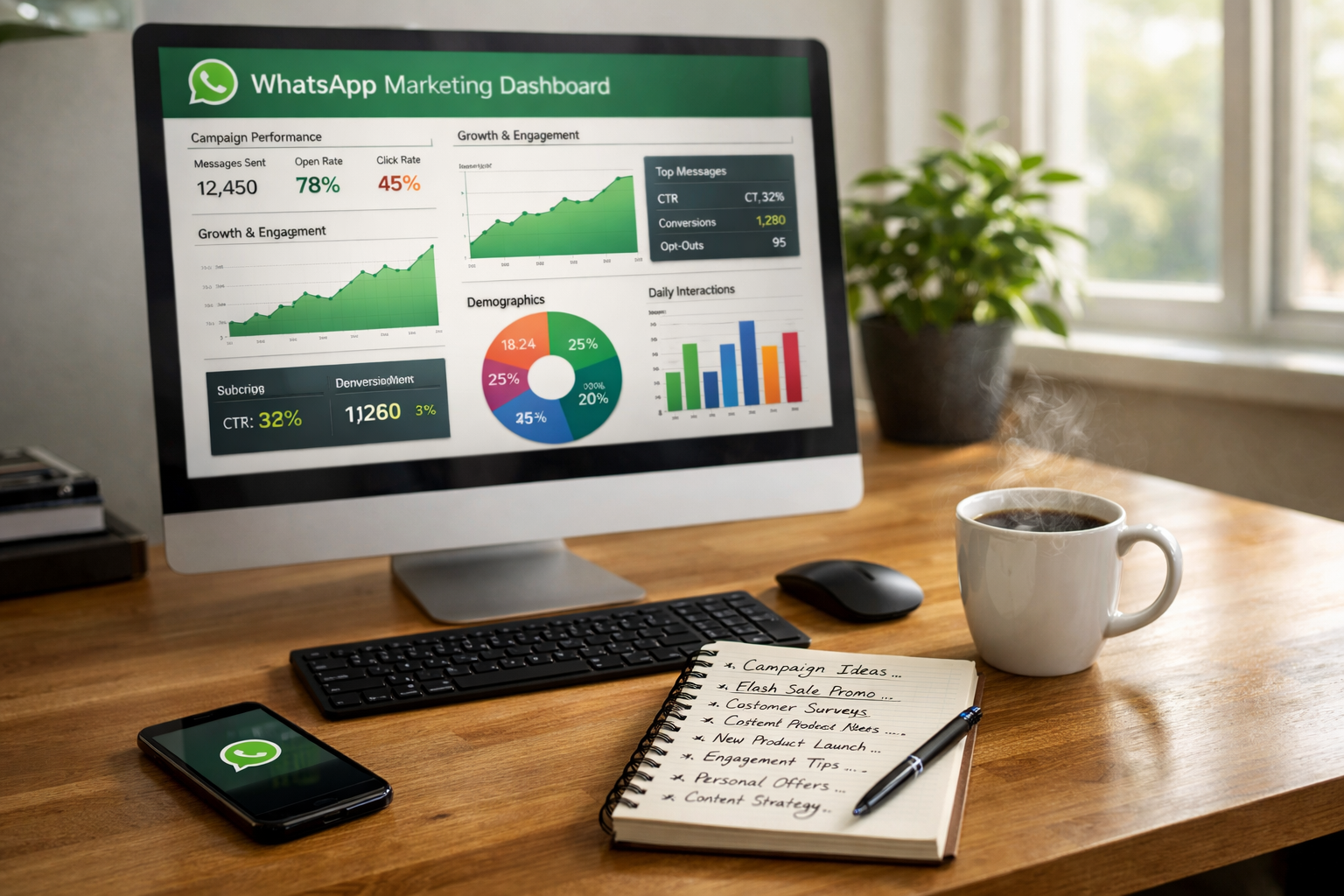
Emails piling up, soulless SMS, chatbots going round in circles: digital marketing is looking for a second wind. WhatsApp is emerging as the channel that genuinely changes things, provided you understand what it is, and what it isn't.
What is WhatsApp Marketing?
WhatsApp Marketing covers all the marketing activity run through the WhatsApp Business API: from collecting opt-ins to sending campaigns, by way of conversational customer service and automated purchase journeys.
In practice, it is using WhatsApp as a communication channel between a brand and its customers: to inform, engage, sell and retain. But behind that simple definition sits an approach radically different from anything that came before.
WhatsApp is not one more channel in the marketing stack. It is a communication space with its own conventions, its own tempo, its own expectations. A WhatsApp message is read on average within three minutes of arriving, in an interface where the user handles professional and personal exchanges side by side.
It is not a newsletter. It is not an SMS. It is not an email with a green bubble.
Email, SMS, chatbot, WhatsApp: what sets them apart
The question comes up often: what is WhatsApp meant to replace? The short answer: none of the three. Each channel occupies a different place in the customer relationship, and WhatsApp occupies one the others don't cover.
| Criterion | SMS | Web chatbot | ||
|---|---|---|---|---|
| Open rate | 15 to 25% | 70 to 80% | Depends on site traffic | 80 to 98% |
| Time to read | Several hours | 5 to 10 min | Immediate, if on the site | Under 3 min |
| Content richness | HTML, images, CTAs | Text only, 160 characters | Custom interface | Text, media, buttons, catalogues |
| Native conversation | No | Limited | On the site only | Two-way, asynchronous |
| Portability outside the session | Yes | Yes | No, tied to the site | A lasting relationship inside the app |
| Opt-in required | Yes, often diluted | Yes | No, started by the visitor | Explicit and documented |
| Cost | Very low | Low to medium | Platform investment | Per message delivered |
The right question isn't which of these channels to choose, but understanding what each does best. In a mature stack, where email informs and SMS alerts, WhatsApp builds the relationship.
The formats of WhatsApp Marketing
WhatsApp Marketing isn't just about sending a promotional message. It covers a broad spectrum of uses, combined according to the brand's objectives.
- Marketing campaigns. Template messages approved by Meta: promotions, product launches, events. The format closest to traditional marketing, with engagement rates that have no equivalent.
- Automations and journeys. Sequences triggered by customer behaviour: cart abandonment, order confirmation, post-purchase follow-up, onboarding. WhatsApp becomes a real-time automated CRM channel.
- Conversational customer service. Inbound requests handled directly in WhatsApp: questions, after-sales, delivery tracking. Response time and customer experience move to another level compared with email.
- Conversational commerce. Catalogue presentation, product recommendations, order taking: the complete purchase journey without leaving the app.
- Retargeting. CRM data personalises the message according to purchase behaviour or segment. Fine-grained segmentation is what separates a broadcast from a conversation.
- Activations and prize draws. Quizzes, photo challenges, polls: mechanics that engage the base, generate content and speed up opt-in collection. The events that keep the channel alive between campaigns.
How it works technically
Professional WhatsApp Marketing runs on the WhatsApp Business API, a technical layer distinct from the consumer app and from the simple WhatsApp Business app. It is what makes sending at scale, CRM integration, automation and multi-agent handling possible.
Access to the API goes through official Meta technology partners. Those partners host the infrastructure, manage template approval, ensure compliance and provide the management interfaces.
The pricing model to remember
Since 1 July 2025, Meta bills each message sent from a template, individually, rather than the 24-hour conversation. Three exemptions remain, and they are what decides your bill: service messages (your replies to a customer who wrote to you) are free; utility messages sent while a service window is open are free too; and a conversation opened from a click-to-WhatsApp ad is entirely free for 72 hours.
The rate depends on the dialling code of the number receiving the message, not on your company's country. Our WhatsApp cost calculator applies these rules across all 38 Meta markets and shows the date of the latest rate-card reading.
The key figures
| Indicator | Value |
|---|---|
| Average open rate of WhatsApp messages | 80% |
| Clicks compared with a standard marketing email | 3 times more |
| Median time to read a received message | Under 3 minutes |
| Active users worldwide | 3 billion |
The three pillars of a strategy that lasts
WhatsApp Marketing is not a one-off tactic. The brands that get lasting value from it have built their approach on three complementary foundations.
- The opt-in base. Everything starts with the quality and size of the base. No bought volume, no list imported without consent: an audience that chose to be there. It is the owned asset that gains value over time.
- The relevance of the message. WhatsApp doesn't forgive irrelevance. A message with no value generates blocks, and Meta watches that rate. Beyond 2% blocks, your account can be restricted: segmentation and personalisation aren't optional, they determine whether the channel is viable at all.
- Conversational continuity. The channel has to stay alive between campaigns. A regular cadence, even a light one, maintains engagement and builds a reading habit that becomes a real competitive advantage.
Which sectors, and which objectives?
WhatsApp Marketing isn't reserved for one type of company or one sector. Its range of application is broad.
- Retail and e-commerce: cart abandonment recovery, upselling after purchase, loyalty, stock alerts and interactive catalogues.
- Food service and hospitality: bookings, confirmations, last-minute offers, review management.
- Healthcare and services: automated appointment reminders, confirmations, patient or client follow-up. Attendance rates improve mechanically.
- B2B and professional services: nurturing, content sharing, sales follow-ups where email gets stuck in overloaded inboxes.
- Training and events: communication before, during and after the event, session reminders, sharing exclusive resources.
In Switzerland, WhatsApp penetration exceeds 70% of the working population. In Spain, Portugal and Brazil, it is close to universal. This is no longer a niche channel; it is the communication infrastructure of a large share of your customers.
The right indicator isn't "which sector does it work in", it is "do your customers use WhatsApp?". If they do, the channel deserves serious consideration.
What you are really building
A well-run WhatsApp strategy is much more than one more channel in your mix. It is an owned asset: a channel you control, not subject to a third-party platform's algorithms, whose value grows over time.
Compare it with your other channels: email suffers from saturated inboxes and increasingly aggressive spam filters. Social networks rent you an audience you don't own: your organic reach can be halved overnight, with no warning.
The WhatsApp Business API gives you something rare: direct, consented, unfiltered access to your customers' attention. That is why building the base isn't a formality: it is the founding investment.
Tool
Work out your real Meta bill →
38 markets, up-to-date per-message rates, exemptions and volume tiers applied. Five minutes to know what WhatsApp will really cost you.
Read next

Conversations that convert
A 30-minute demo is enough to see what your WhatsApp channel can produce. In Geneva or by video call.