


WhatsApp has become a strategic channel for SMEs and B2B companies in Europe. The observation is simple: your customers are already there, your sales reps already reply there, but your stack hasn't followed.
Most WhatsApp Business API solutions were designed for consumer use cases. That is not what a mid-sized company needs to qualify a prospect, run a long sales cycle, or support a multi-country customer base.
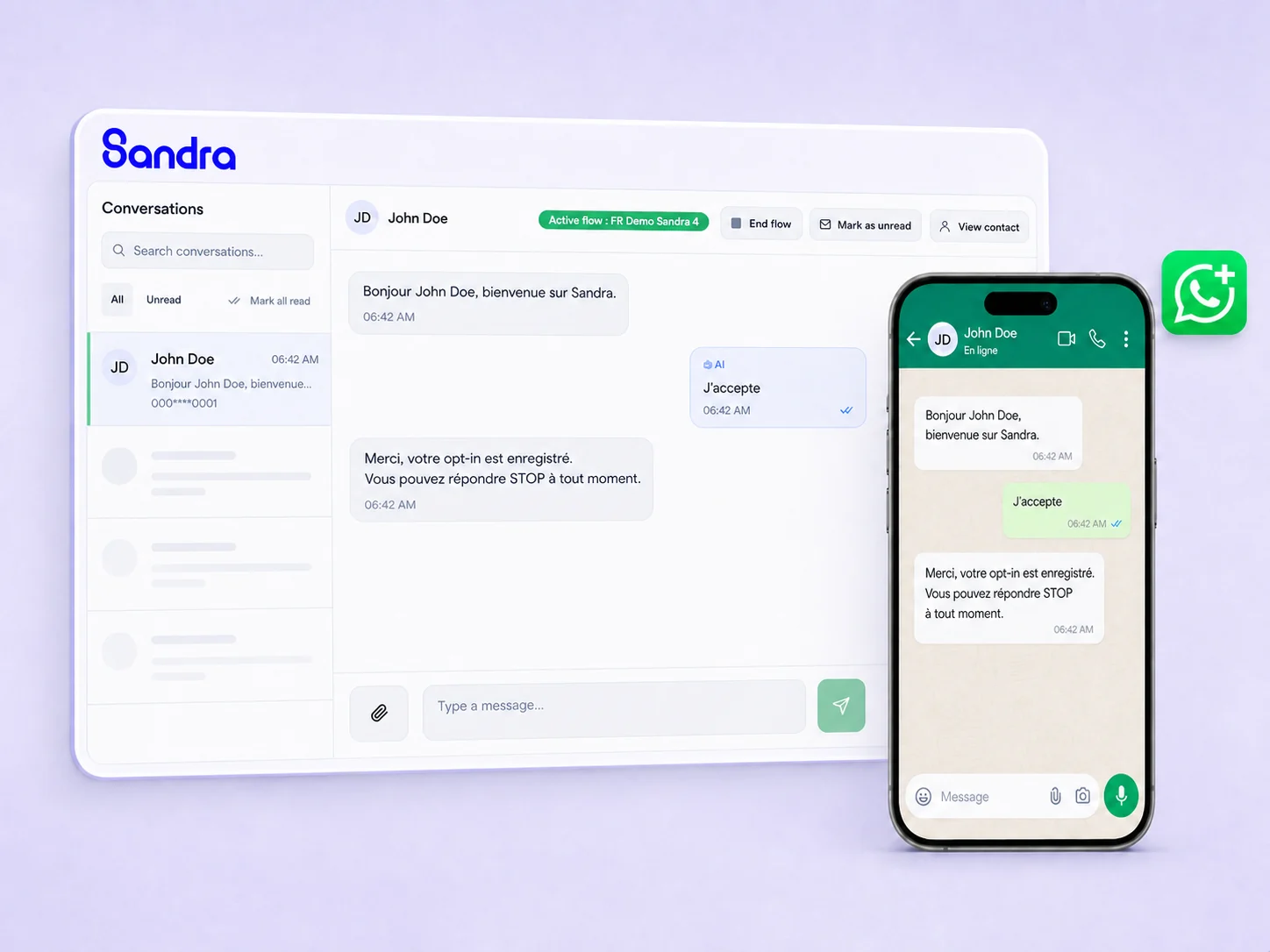
Sandra addresses that gap: a Swiss WhatsApp Business API integration platform, built for European companies, with B2B conversational sales, support automation, payments and a product catalogue embedded in the conversation.
Why WhatsApp is taking hold in B2B
| Indicator | Performance | B2B implication |
|---|---|---|
| WhatsApp open rate | 80% | 4× higher than email |
| Email open rate | 20% | A ceiling that is hard to break |
| SMS open rate | 60% | Suited to short transactional messages |
| Conversational trust | 72% | Buyers want a dialogue |
The limits of current solutions
Many companies have already tried, often with frustration. Three pitfalls come up every time.
Outbound push dressed up as conversation
Existing marketing tools treat WhatsApp as a mass-sending channel. They let you send a templated message, but not run a conversation that lasts several days across a complex sales cycle.
- A prospect who replies triggers no intelligent journey
- The sales rep has to switch manually to another interface
- No conversational memory between interactions
- Attribution is lost between the CRM and the sending tool
The generic chatbot with no context
Dropped onto WhatsApp, standard chatbots answer as if they were discovering the contact at every interaction: they don't know who they are or where they stand in the sales cycle, they are unaware of open tickets and they have no access to the internal knowledge base. The result is a degraded experience rather than an improved one.
Data sovereignty
The WhatsApp Business API runs on Meta, but the application-layer processing of conversations may travel outside the EU depending on the integration provider chosen. That means GDPR and FADP risk for regulated players, compliance files reopened at every audit, and recurring blockers in sensitive industries.
Comparing the approaches
| Criterion | Marketing tools | Generic chatbots | Sandra |
|---|---|---|---|
| Intelligent conversation | No | Limited | Yes |
| CRM connection | Partial | Partial | Native |
| EU and Swiss data | Not guaranteed | Not guaranteed | Yes |
| No code | Limited | Partial | Full |
| Catalogue and payments | No | Limited | Built in |
The platform's six modules
| Module | What it does | Benefit |
|---|---|---|
| No-code conversation designer | Visual building of conversational journeys | Marketing teams deploy without a developer |
| EU and Swiss data | Hosting and processing exclusively in Switzerland and the EU | GDPR and FADP compliance by default |
| Multichannel inbox | WhatsApp and web chat in a single interface | Omnichannel support run by one team |
| Rich WhatsApp experiences | Carousels, buttons, forms, catalogue, payments | Conversion native to the conversation |
| Conversational analytics | Business metrics connected to conversations | End-to-end attribution |
| AI agent studio | A contextual agent plugged into the CRM and the knowledge base | A relevant answer from the first message |
Use case: B2B sales
Sandra qualifies inbound leads on WhatsApp and web chat, schedules sales meetings automatically, and feeds the CRM in real time. Sales reps no longer come to a call cold: they open a conversation that is already framed.
- Automatic lead qualification against the company's own criteria
- Intelligent routing to the right rep by territory, language or profile
- Booking straight into the rep's calendar
- Scheduled conversational follow-ups on paused leads
- Product presentation through carousels and triggerable demos
- Payment and upsell directly inside the conversation
Measured with Sandra customers: up to half the cost per lead compared with traditional digital channels.
Use case: customer support
The contextual AI agent handles everyday requests with no human involvement. Complex requests are escalated to an agent with the full conversation history.
- Instant 24/7 answers to frequent questions
- Preliminary diagnosis of technical incidents
- Checking the status of an order, subscription or ticket
- Automatic ticket creation with enriched context
- Escalation to a human agent with the full transcript
- Post-resolution follow-up and satisfaction measurement
Measured with Sandra customers: up to 40% of support requests resolved automatically.
Fitting into the rest of the stack
| Integration | Direction | What it brings |
|---|---|---|
| CRM (HubSpot, Salesforce, others) | Two-way | Conversations enrich the CRM, the CRM informs the AI agent |
| Helpdesk | Two-way | Tickets created automatically, history attached |
| Knowledge base | Read | The AI agent answers with up-to-date data |
| In-house AI agents | Open API | Sandra routes to the customer's own agents |
| Analytics stack | Outbound | Conversation data feeds the dashboards |
Start without risk, scale in stages
| Phase | Duration | Objective |
|---|---|---|
| 1. Proof of concept | 1 month | Validate one priority use case, go or no-go on measured results |
| 2. Integrated pilot | 1 month | Roll out across a full business unit, CRM and helpdesk integration |
| 3. Deployment | Sized to the scope | Extend to other entities, geographies or use cases |
Which companies this is for
- A conversational sales cycle, where trust and closeness count
- Enough leads or tickets to justify automation
- Marketing and support teams that want to operate without depending on a developer
- An existing CRM and helpdesk stack the company does not want to replace
- Strong regulatory requirements on where data sits
- The ambition to make WhatsApp a strategic channel, not an experiment
Read next

Conversations that convert
A 30-minute demo is enough to see what your WhatsApp channel can produce. In Geneva or by video call.