
Actualités
WhatsApp pricing: what changes on 1 October 2026
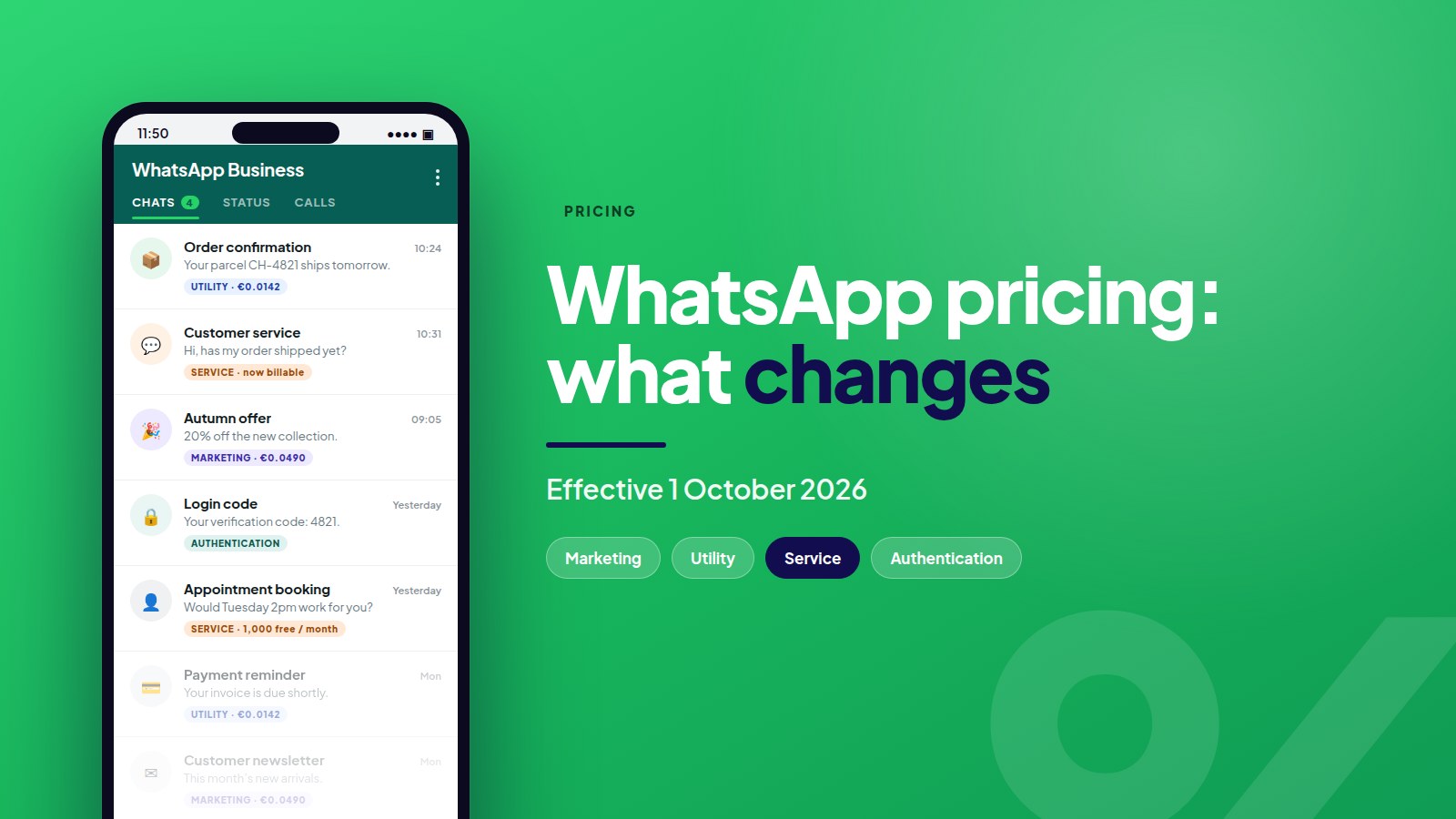
Service messages become billable beyond 1,000 per month and utility messages sent inside a service window lose their free status. In Switzerland the rates don't move: what disappears is what used to be free.

The rates quoted in this article are those of the Meta rate card on that date. Meta changes it and gives a month's notice: this article stays the reference point for its period and is not updated.
See the current rate card in the calculator →On 27 May 2026, with four months' notice instead of the usual one, Meta announced three changes to WhatsApp Business billing that take effect on 1 October 2026. For a Swiss company, the essentials fit in a single sentence: your rates don't move, but part of what used to be free becomes billable.
The three changes
Service messages become billable. Until now, replying to a customer who wrote to you cost nothing, whatever the volume. From 1 October, Meta bills them at the same rate as utility and authentication messages, market by market, with an allowance of 1,000 service messages per business phone number per month.
Utility messages sent as replies become billable again. Since July 2025, a utility message sent while a 24-hour service window was open (a shipping confirmation following a customer question, for example) was free. That exemption disappears. It is the heaviest change, and the least visible.
Nine markets leave their pricing region. Bangladesh, Iraq, Kazakhstan, Kuwait, Morocco, Nepal, Oman, Sri Lanka and Ukraine leave their "Rest of" zone to appear on their own in the rate cards, with their own prices. No Western European market is affected.
For Switzerland, the rates stay the same
The price increases announced for 1 October concern marketing in Kuwait, Mexico, Morocco, Saudi Arabia, the United Arab Emirates, the rest of the Middle East and the rest of Asia-Pacific. On the utility and authentication side, the moves affect Kazakhstan, Kuwait, Morocco, Oman, Pakistan, Peru, South Africa and Ukraine upwards, and Bangladesh, Iraq, Nepal and Sri Lanka downwards.
Switzerland appears nowhere on that list. It isn't even a named market at Meta: +41 numbers fall under the Rest of Western Europe zone, together with Austria, Belgium, Denmark, Finland, Ireland, Norway, Portugal and Sweden. A utility message there costs €0.0142, a marketing message €0.0490. Those amounts do not change on 1 October.
What changes is the scope of what gets billed.
A worked example
Take a Swiss online retailer writing to Swiss customers. Each month it sends 2,000 marketing messages, 6,000 utility messages (order confirmations and shipping updates), half of which go out while a conversation is open, and replies to 4,000 inbound messages.
| Item | Monthly volume | Until 30 September | From 1 October |
|---|---|---|---|
| Marketing | 2,000 | €98.00 | €98.00 |
| Utility | 6,000, of which 3,000 inside a service window | €42.60 | €85.20 |
| Service | 4,000 | free | €42.60 |
| Total | €140.60 | €225.80 |
The bill goes up by €85 a month, or 61%, without a single rate having moved and without a single extra message having been sent. Over a year, the gap exceeds €1,000. And if you isolate the conversational share (utility replies plus service messages), it goes from €42.60 to €127.80: it triples.
Who is affected, and who isn't
A company that uses WhatsApp purely for outbound campaigns will see nothing change. Marketing isn't concerned, and never was covered by these exemptions.
Affected, on the other hand, is every company whose volume is driven by inbound requests: customer service, order tracking, appointment booking, reservations. The more your channel works like a conversation and the less like a broadcast, the more the change costs you. Which is somewhat paradoxical, since that is exactly the usage Meta spent two years encouraging.
What you can do between now and then
Count your numbers. The 1,000 service message allowance is granted per business phone number, not per account. A company running three numbers (one per brand, one per country, one for support) has 3,000 free messages a month. That's the first figure to check in your setup.
Measure before you absorb. Few companies know what share of their utility messages goes out inside an open service window, because until now that share was free and therefore never appeared on the invoice. It will appear in October. Look at it now.
Look after the free entry points. A fully free 72-hour window opens when a customer writes to you from a click-to-WhatsApp ad or from the WhatsApp button on a Facebook Page. That exemption is unchanged, and it is now the only mechanism that wipes out an entire invoice line, across all categories.
Cut the pointless back-and-forth. A flow that settles a request in three messages instead of seven cost the same yesterday. It will cost less tomorrow.
How we checked this
This information comes from Meta's developer documentation, section "Pricing updates", consulted on 4 September 2026. The 1 October rate cards are already published there.
The amounts quoted in this article are those of the rate card in force on its publication date. For an estimate based on your own volumes, with up-to-date rates for all 38 Meta markets, our calculator already applies the 1 October rules.
Tool
Work out your real Meta bill →
38 markets, up-to-date per-message rates, exemptions and volume tiers applied. Five minutes to know what WhatsApp will really cost you.
Read next

Conversations that convert
A 30-minute demo is enough to see what your WhatsApp channel can produce. In Geneva or by video call.